Keene on AI
AI tokens for real estate agents: why markdown files use fewer
October 16, 2026
The short answer.
AI tools like Claude and ChatGPT read and write in tokens, small pieces of words, and every token counts toward your usage limits. A markdown file gives the AI only your words plus a few symbols for structure, so it uses far fewer tokens than a PDF, which Claude can read as both text and a picture of every page.
- One token is about four characters, or about three quarters of a word.
- Everything counts toward your limit: your message, your uploaded files, and the reply.
- When Claude reads a PDF with its visual understanding, each page becomes text plus an image, and the image adds tokens.
- A markdown file (.md) is plain text with simple symbols, like a pound sign for each heading.
- Every Keene on AI kit includes a markdown file built for uploading to Claude or ChatGPT.
AI tokens for real estate agents come down to one idea: every word you type, every file you upload, and every reply you get back is counted in small pieces called tokens. The fewer tokens your files use, the further your Claude or ChatGPT plan goes, and the more room the AI has for the work that matters. Markdown files are the leanest way to give AI your information.
I'm Polly Keene, AI Trainer and Consultant and founder of Keene on AI. When I build tools for agents, I think about tokens the way you think about square footage. Every inch should earn its place.
What is a token in AI?
A token is a small piece of text that an AI tool reads or writes. Short, common words are usually one token. Longer or unusual words get split into two or three. OpenAI's rule of thumb for English is that one token is about four characters, or about three quarters of a word, so 100 tokens is roughly 75 words.
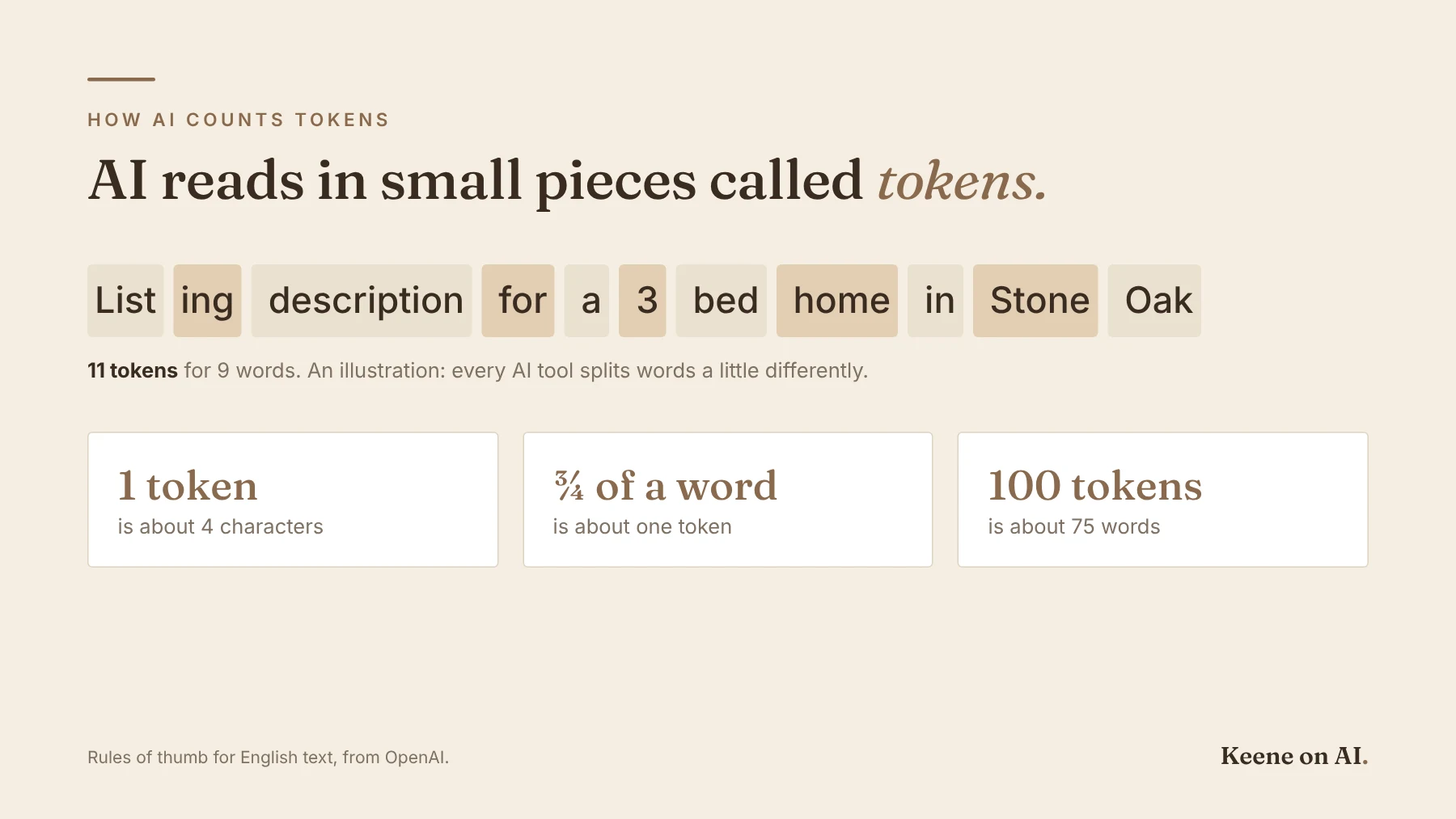
Tokens matter because AI plans are measured in them. Anthropic's Claude Help Center lists the size of your file attachments and the length of your conversation among the things that affect your usage limits. Upload heavy files, and you reach your limit sooner.
How does AI count the tokens in a file you upload?
It depends on the file type. A plain text or markdown file is simple: the AI reads the words, and the words are what count.
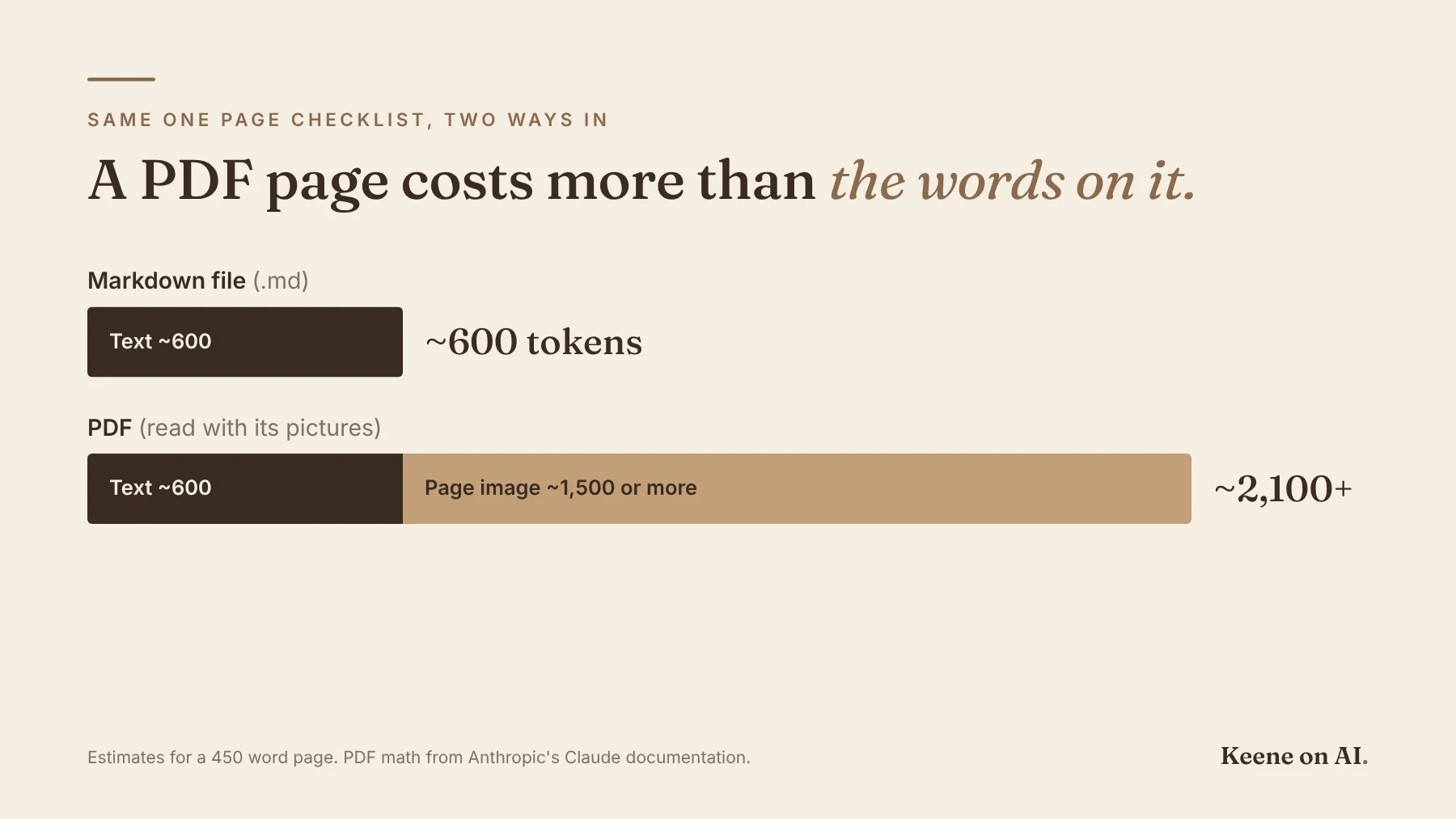
A PDF can cost much more. Anthropic's developer documentation explains that when Claude reads a PDF with its full visual understanding, each page is turned into an image, and the text on that page is pulled out and sent along with it. Claude reads both, which is great for charts and floor plans, but you use tokens for the text and the picture. The same documentation says the text alone typically runs 1,500 to 3,000 tokens per page, depending on how dense the page is, and a full page image can add roughly 1,500 tokens or more on its own.
Anthropic's own example makes the gap clear. A three page PDF read as text only came to about 1,000 tokens. The same PDF read with full visual understanding came to about 7,000. That is seven times the tokens for the same words.
Why do markdown files use fewer tokens?
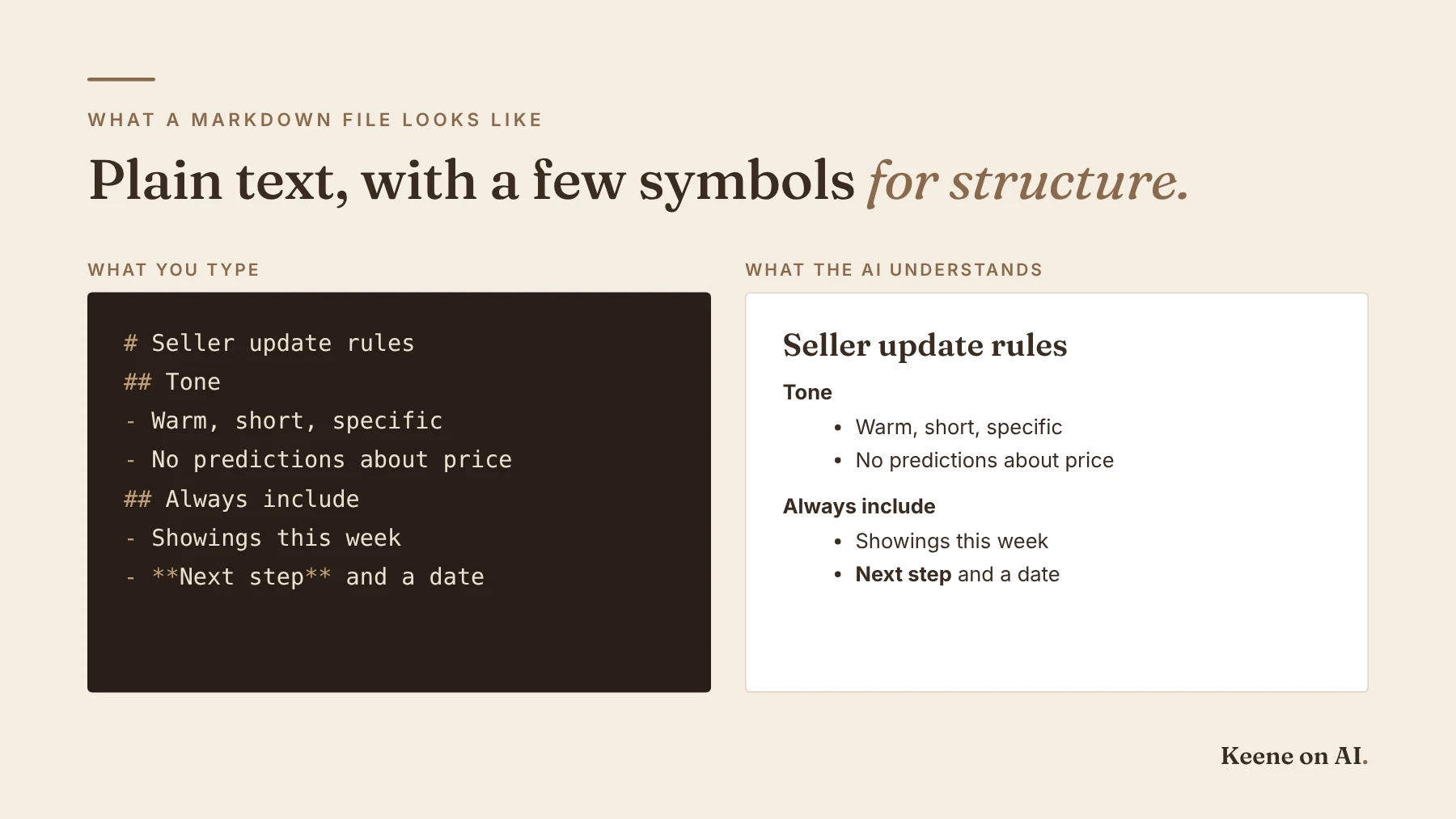
Because a markdown file is just your words. There are no fonts, page layouts, margins, or pictures of pages for the AI to process. The only extras are a few simple symbols that show structure, like a pound sign in front of a heading or a hyphen in front of a bullet. Those symbols cost almost nothing, and they help the AI see which lines are headings, which are rules, and which are examples.
Markdown is also the format AI already speaks. Claude and ChatGPT both use markdown to format their answers, which is why you see bold text and bullet points in a chat. Claude Skills are built on a markdown file called SKILL.md.
Why does every Keene on AI kit include a markdown file?
Every Keene on AI product is designed to upload as a markdown file and use the fewest tokens possible. Whether the kit is a prompt for a Claude Project, a ChatGPT Project, or an installable Claude Skill, it includes a .md file built for the AI to read. You still get a PDF guide and a printable checklist for you to read. The PDF is for people. The markdown file is for the AI.
That choice gives you three things:
- More usage. Your project files take up less of your plan every time you start a chat.
- Cleaner instructions. The AI sees clear headings and rules, not page breaks and footers.
- Room to work. Fewer tokens spent on instructions leaves more room for your listing notes, your MLS data, and the conversation itself.
You can browse every kit in The Listing Desk.
How do you save your own documents as markdown?
- From Google Docs: open the doc and choose File, then Download, then Markdown (.md).
- From Word or a PDF: paste the text into Claude or ChatGPT and ask it to convert the text into clean markdown with headings and bullets. Copy the result.
- Save the file: on a Mac, paste into TextEdit, choose Format, then Make Plain Text, and save with .md at the end of the file name. On Windows, paste into Notepad, set Save as type to All files, and save with .md at the end of the file name.
- Upload it to your Claude Project or ChatGPT Project in place of the PDF or Word version.
More ways to use fewer AI tokens
- Start a new chat for each new topic, since long conversations count against your limits.
- Keep the files you use often in a Project. Claude's Help Center says project content is cached and counts less against your limits when you reuse it.
- Trim your files. Delete old drafts, repeated sections, and anything the AI does not need.
- Save PDFs for the times you need the AI to see a chart, a photo, or a floor plan.
- Combine related questions into one message instead of sending several short ones.
Where to go next
Pick the one file you upload most, maybe your brand guide or your listing checklist, and save it as markdown this week. If you want tools that already come ready to upload, browse The Listing Desk. You can also keep reading in Insights, see how we can work together, or book a call.
Frequently asked questions
What is a token in AI?
A token is a small piece of text that an AI tool reads or writes. In English, one token is about four characters, or about three quarters of a word, so 100 tokens is roughly 75 words. Your messages, uploaded files, and the AI's replies are all counted in tokens.
Why should real estate agents care about tokens?
Because your Claude or ChatGPT plan is measured in them. Large files and long conversations use more of your limit, so lean files let you get more work done before you hit a cap. Lean files also leave more room for your listing notes and client details.
Do PDFs always use more tokens than markdown?
Not always. If a tool only pulls the text out of a PDF, the cost is close to the words on the page. When Claude reads a PDF with its full visual understanding, each page also becomes an image, and that image adds tokens. A markdown file never carries the cost of a picture.
What is a markdown file?
A markdown file is a plain text file that ends in .md. It uses a few simple symbols for structure, like a pound sign for a heading and a hyphen for a bullet point. You can open and edit one in Notepad, TextEdit, or Google Docs.
Can ChatGPT read markdown files?
Yes. Claude and ChatGPT both accept .md files as uploads in chats and in Projects. Both tools also use markdown to format their own answers.
Should I stop using PDFs with AI?
No. Use a PDF when the AI needs to see something visual, like a chart, a photo, or a floor plan. For instructions, rules, checklists, and brand guides that are mostly words, a markdown file does the same job with fewer tokens.
Why do Keene on AI products include markdown files?
Every Keene on AI kit is designed to upload as a markdown file so it uses the fewest tokens possible in Claude or ChatGPT. Each kit also includes a PDF guide and checklist for you to read and print. The PDF is for people, and the markdown file is for the AI.
Sources: OpenAI: what are tokens and how to count them; Anthropic: PDF support and Anthropic: vision and image costs; Claude Help Center: usage limit best practices. Checked October 16, 2026.